Why intranets fail: governance, not technology
When an intranet starts to creak, organisations rush to blame the same culprits.
The platform is wrong. The vendor oversold it. The implementation missed something. Budget was cut. Search is poor. Navigation feels messy. Nobody trusts the homepage and employees keep asking questions that were supposedly answered months ago.
The instinct to blame technology is understandable. After all, the problems show up on the platform itself.
But the platform is rarely the real issue. More often, the trouble sits beneath it – or nowhere at all. Because when intranets and digital workplaces struggle, the problem is usually governance. And governance has a PR problem.
The word itself sounds bureaucratic – the sort of thing that appears in a steering committee deck and sucks the energy from the room. But governance is not bureaucracy for its own sake – it’s simply clarity:
who decides what
on whose behalf
within what boundaries
and how those decisions get implemented
When governance is working, nobody mentions it. When it’s missing, everybody feels it.
The platform didn’t fail. The foundations did.
We often talk about digital workplaces as though they’re products. Buy the right one, configure it properly, and the problem is solved.
Reality is, regrettably, a lot messier.
Digital workplaces evolve over time. New tools appear. Teams create workarounds. Departments build their own spaces. Ownership shifts. Priorities change. Before long, what started as a coherent platform becomes a patchwork of overlapping sites, competing content and improvised decisions.
This is why most digital workplace failures aren’t caused by a bad technology choice. Instead, they’re death by a thousand sensible decisions.
The symptoms are familiar. Search results are cluttered with duplicate or outdated information. Multiple teams launch overlapping tools. The homepage becomes a battle where visibility becomes political. Publishing standards vary wildly between departments. Nobody’s quite sure who owns what, or who gets to decide when things conflict.
Your homepage isn’t a leaderboard – but without governance it becomes one.
And when that happens, trust erodes. Employees stop believing the intranet is reliable because there’s no clear source of truth. They revert to asking colleagues, digging through old downloads or relying on unofficial channels.
The technology is working perfectly well, but the employee experience is not.
That distinction’s important – because if you diagnose the wrong problem, you buy the wrong solution. As we argued in our earlier post on intranet audits versus discovery, many organisations optimise what already exists rather than questioning whether it works in the first place.
A simple diagnostic: which governance layer is broken?
As we explored in our post on the five-layer model, digital workplaces work as connected ecosystems rather than isolated tools. Governance is part of that architecture.
In our governance model, there are three distinct layers: Programme, Platform and Content. Each solves different problems. Each breaks in different ways.
The useful question is not, “Do we have governance?” It’s, “Which layer is broken?”
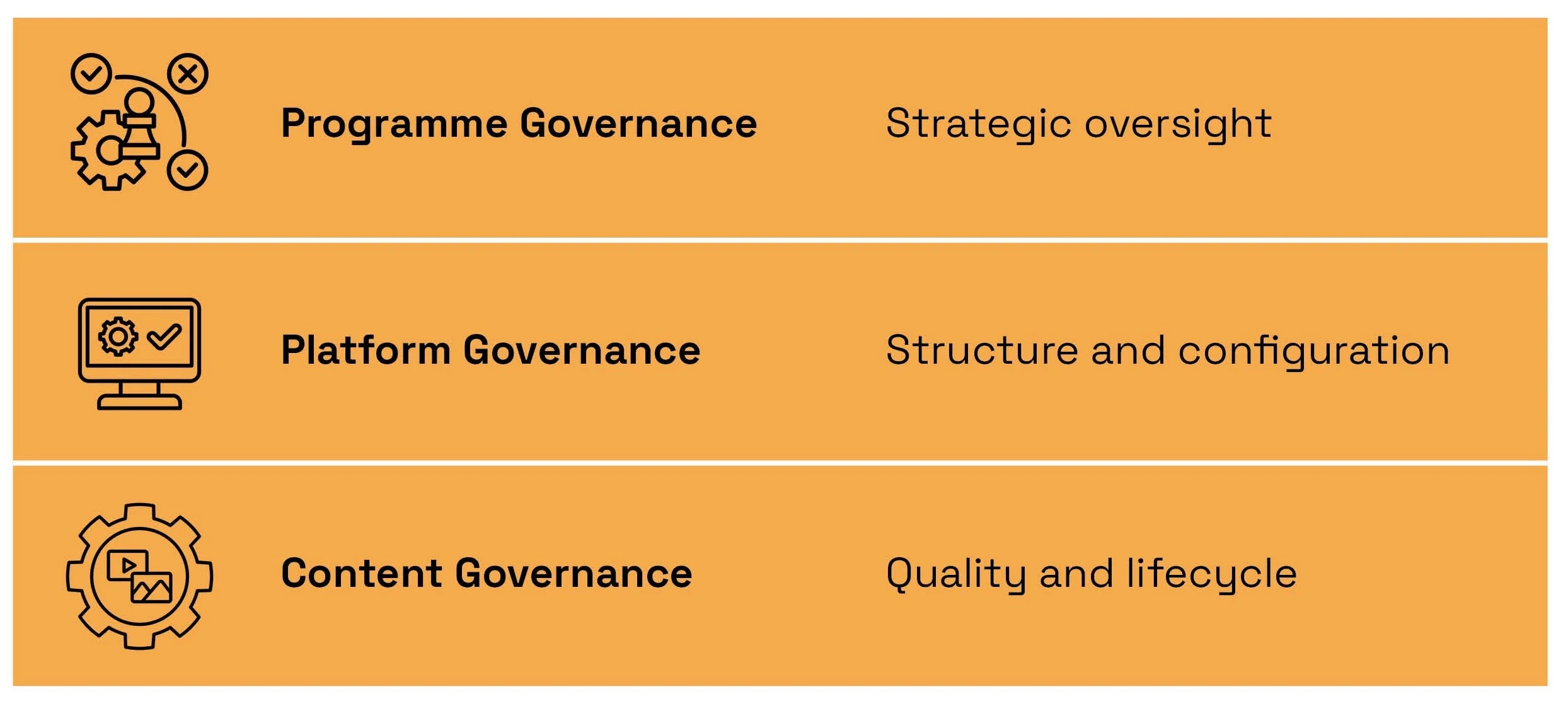
Programme governance sits at the strategic level.
This is the layer that keeps the digital workplace coherent as a whole. It brings together comms, IT, HR, operations and other functions to align priorities, oversee investment and avoid duplication.
Without it, teams make sensible local decisions that create organisational chaos.
One department launches a new tool while another is already solving the same problem elsewhere. Platform decisions get made without considering communication impact. Comms teams are asked to “make it land” after major decisions have already been made.
Programme governance prevents this fragmentation by creating joined-up ownership.
It doesn’t need to be elaborate. Often a regular cross-functional forum with a clear agenda is enough to start creating alignment. Because programme governance is not about central control. It’s about making sure the organisation is solving problems together rather than creating them separately.
Platform governance is more operational.
If programme governance sets direction, platform governance manages the mechanics.
This is where decisions about navigation, permissions, templates, targeting, integrations, accessibility and search live. It determines whether the platform stays usable, scalable and coherent as it grows.
Without platform governance, drift creeps in. Templates multiply. Navigation fragments. Search deteriorates. Targeting becomes unreliable. Site structures evolve according to whoever shouted loudest or moved fastest.
And platform trust declines. That matters because usability remains one of the strongest predictors of satisfaction in digital communication.
Content governance, meanwhile, governs what people actually see.
This covers publishing permissions, ownership, metadata, standards, review cycles, localisation, homepage escalation and the routines that keep information accurate and trustworthy.
Without content governance, old content proliferates and accountability evaporates. Comms teams end up trapped in firefighting mode, chasing broken pages and outdated policies while trying to protect standards they cannot enforce alone.
The result is predictable: clutter, inconsistency and declining trust.
The three layers work together – ignore one and the whole ecosystem becomes unstable.
We unpack each layer, with a diagnostic checklist for spotting which one is broken, in Chapter 6 of Digital Communications at Work.
Centralised versus decentralised is usually the wrong argument
Governance debates often get stuck in a false choice: Is everything centrally controlled? Or should teams have complete publishing freedom?
Neither works particularly well.
Fully centralised models create consistency, but often at the cost of speed and local relevance. Bottlenecks appear. Publishing slows. Teams bypass the process because it feels impossible to navigate.
Fully decentralised models move faster, but consistency and quality suffer. We explored this tension in our earlier post on why standardisation isn’t the enemy of usability – and why unchecked flexibility often creates more friction than freedom.
Most organisations do better with something in between – guardrails, not gates.
That means central standards where consistency matters – things like templates, accessibility, metadata, navigation principles and publishing rules – combined with local autonomy to create and manage content within those boundaries.
Think cycle lanes rather than roadblocks. The purpose is not restriction for its own sake. It’s creating enough structure for trust and enough flexibility for relevance.
The same principle applies globally. Large organisations often struggle with tensions between global and local ownership – universal standards versus regional nuance, consistency versus legal or cultural difference.
Again, hybrid usually wins. Global teams define strategy, templates and universal standards. Regional and local teams adapt content, manage nuance and handle operational reality.
Clear ownership matters more than rigid control.
Governance is not a launch deliverable
Good governance often dies after go-live.
Governance is designed during implementation. Roles are defined. Rules are written. Decision models are agreed. Then the project launches and governance slips away. This is the “launch and abandon” problem.
Organisations often behave as though governance can be fixed once and finished forever. But digital workplaces don’t stand still. Tools change. Teams change. Structures change. Employee needs change.
Governance needs to evolve alongside them. Not because the original model was wrong, but because successful systems grow. That means reviewing governance regularly, using analytics and feedback to refine what works, and accepting that mature governance becomes more enabling over time, not more restrictive.
Belligerence and certainty are poor governance strategies. Adaptation is usually the healthier instinct.
Systems don’t sustain themselves. People do.
It’s tempting to think governance lives in policies, templates or approval flows.
It doesn’t. Those things help, but they’re not the system – people are.
Good governance depends on relationships, routines, accountability and leadership support. It depends on skilled owners who understand both the platform and the people using it. It depends on decisions being made consistently and transparently.
The human layer is not an optional extra. It’s the operating system beneath everything else. Because governance is not really about control. It’s about confidence. Confidence that people know where to publish. Confidence that information is accurate. Confidence that ownership is clear and the platform will still make sense six months or a year from now.
When governance is mature, it becomes almost invisible. No friction. No arguments. Just clarity. And that’s usually the point where people stop blaming the technology.
Because the platform was never really the problem. The foundations were.
Digital Communications at Work (Kogan Page, July 2026) is available for pre-order now. It explores governance in depth in Chapter 6 – from programme, platform and content governance to ownership models, operating structures and the routines that keep digital workplaces healthy as they evolve.